Dialectica Origin: a data product MVP built on Webflow Cloud
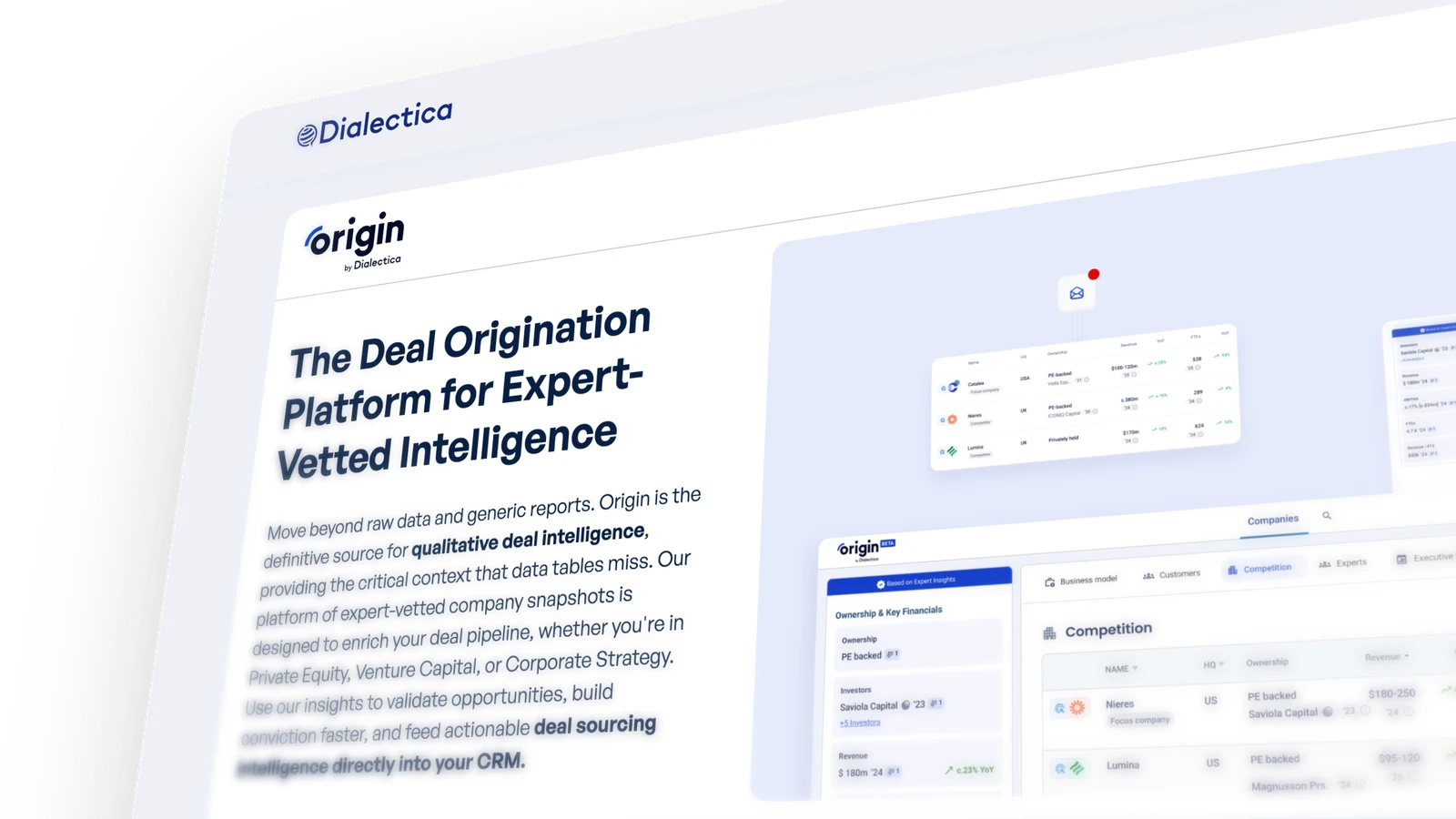
A fast data-product MVP built with Astro, Webflow Cloud, Neon, and AI-assisted development.
Dialectica first asked whether Origin data could be integrated inside Webflow. The answer became clear almost immediately: not properly. Origin had more than 10.000 records to work with, Dialectica was already using a lot of their Webflow CMS capacity, and the product needed relational data, search, filtering, and freemium data masking. This was not a CMS configuration problem. It was a data product MVP that needed Fred to move quickly without bending the wrong tool.
The request that outgrew the CMS before it started
Dialectica runs Origin, a deal intelligence platform used by private equity, venture capital, and corporate strategy teams. They wanted to bring part of that product to the public web: a free, searchable version of their company database on their main domain.
That domain mattered. A subdomain would have been easier technically, but it would have separated Origin from the main Dialectica website. The preferred destination was dialectica.io/origin, inside the same site structure visitors already knew.
Webflow CMS was the obvious first question, but it was the wrong answer. At the time, the Webflow CMS cap for the project was 10.000 items. Origin was already beyond that number, and Dialectica’s site already had CMS content of its own. Even without the item limit, Origin needed relational company data, industry groupings, investor data, financial ranges, ownership filters, search, pagination, and masked fields for the freemium experience.
Trying to force that into Webflow would have made the project fragile from day one.
Choosing a product architecture instead of a CMS workaround
The first technical direction was an Astro application hosted on Cloudflare, with routing or proxy work to make it appear inside a /origin path on the Webflow site. It could have worked, but it would have added infrastructure complexity before the product had even proved itself.
Then Webflow Cloud launched at exactly the right time.
That changed the shape of the build. Dialectica could keep the marketing site in Webflow. Origin could run as an Astro application on the same domain, deployed through Webflow Cloud. No separate subdomain. No heavy reverse-proxy setup. No attempt to turn Webflow CMS into a database.
Fred worked directly with Dialectica, using Astro for the application layer, React for the interactive filters and forms, and Neon for serverless Postgres. Dialectica provided the company data as JSON exports, which GOMO imported into Neon using Python scripts. Webflow continued doing what it does well: managing the marketing site. Origin handled the structured data, filtering, and programmatic pages separately.
From the first JSON file to a prototype in days
The surprise was how quickly the first version came together.
Once Dialectica shared the first JSON export, Fred had a working prototype in a few days. AI-assisted development helped with the TypeScript logic, data import scripts, React components, and edge-runtime debugging. Webflow Cloud also made deployment straightforward, with a dedicated dashboard that kept the process clear.
The build was still technically deep. Company pages, industry pages, and filtered listing pages all needed to render from database queries. The filter interface needed to support industry, location, ownership type, revenue range, growth range, sorting, and pagination. The system also needed dynamic metadata, structured data, canonical URLs, and a sitemap so the generated pages could be indexed by Google.
But the workflow was fast enough to let the project behave like an MVP: build the first usable version, test the model, then keep expanding it.
Showing enough data without giving the product away
Origin’s public version had to prove value without exposing the full dataset.
GOMO built masking into the server-side data layer, so sensitive values are transformed before they reach the browser. Revenue figures, investor names, and other gated fields keep their shape, but not their full meaning. A CSS blur adds a visual locked-state on top, but the real protection happens before the HTML is sent.
That made the public pages useful for discovery while still supporting Dialectica’s commercial model. Visitors can understand the kind of intelligence Origin provides, then convert when they need the full detail.
The result: a fast MVP with 1.500+ live company pages
The MVP launched in under two months, built by one developer with AI support throughout. That was the strongest proof point: Dialectica got a real public data product quickly, without rebuilding their main website and without waiting for a large engineering team.
Origin now has 1.500+ company pages live, with an architecture designed to grow beyond 10.000 records. Adding companies means importing updated data. Adding page types means extending the Astro routes. The system is not constrained by Webflow CMS item limits, relational-field limits, or the lack of advanced native filtering.
Google has indexed Origin pages, and some are already ranking on the first page for relevant searches. That search visibility was not accidental. The programmatic SEO direction was developed in collaboration with Samuel Olsson at Kurve, then translated into a technical system that could turn structured product data into indexable, useful pages at scale.
For teams trying to validate a Webflow-connected product idea quickly, this is the kind of Webflow Cloud MVP development Fred likes most: choose the smallest architecture that fits the real constraints, move fast, and avoid bending the wrong tool until it breaks.
If the product also needs to live inside a Webflow site, Webflow Cloud development gives us a practical path: keep the marketing site visual, and run the application where real application logic belongs.
Key Results
One-developer MVP
One developer, AI-assisted, took the product from first JSON import to live MVP in under two months.
Webflow CMS limits avoided
Origin runs from a Neon database instead of competing for Webflow CMS space or forcing complex relational data into the wrong tool.
Programmatic SEO working
Company and industry pages are indexable, with some Origin pages already reaching first-page Google results.
Built for continued growth
The system serves 1.500+ company pages today and can grow past 10.000 records without changing the core architecture.
Client Feedback
Working with Frederico was a great experience from start to finish. This project was key to our marketing and go-to-market strategy for a new product launch, so the stakes were high. What stood out most was the combination of responsiveness and quality. Deadlines were always met without the back-and-forth that typically slows projects down. The delivery was virtually bug-free, and required minimal revisions, which speaks volumes about the quality of work and attention to detail.
Panagiotis Papachristofilou